












































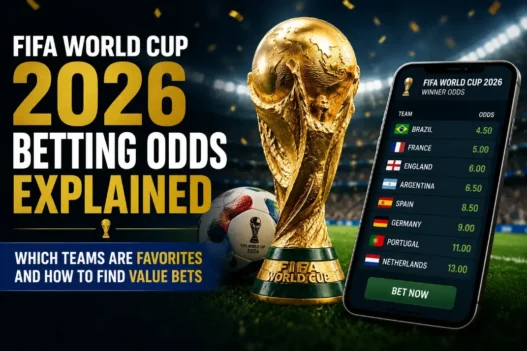
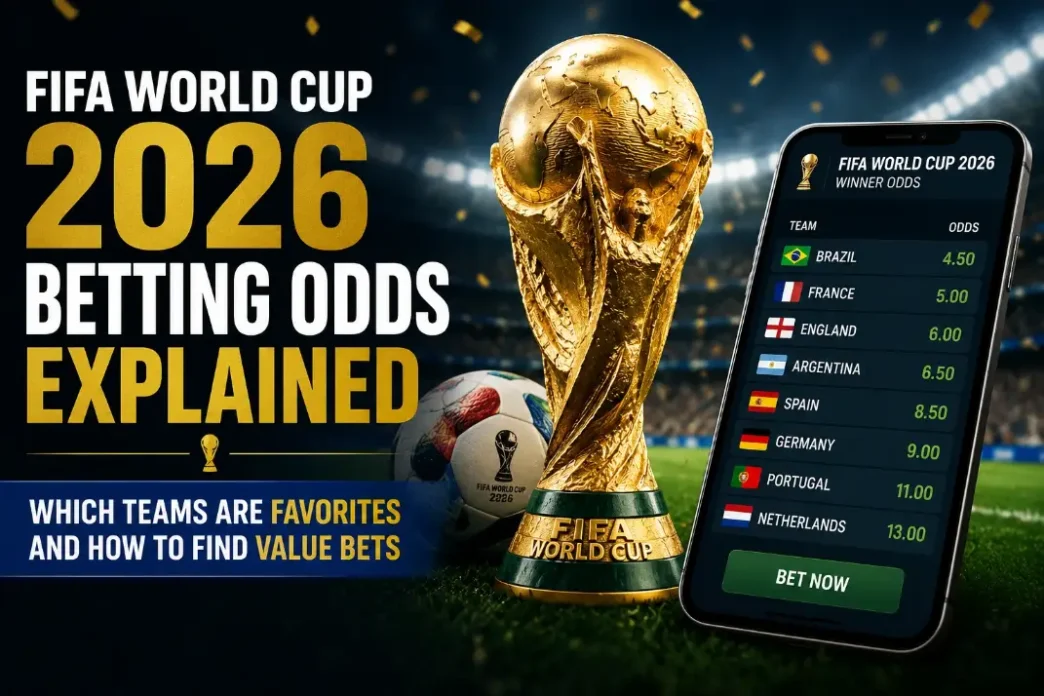
The last time you checked the World Cup odds, you probably had the same reaction as most bettors: nothing new here. The usual names are at the very top again. Brazil. France Argentinian England is not far behind either. That’s how it always begins.
But early odds aren’t really about picking a winner. They are more of a first draft. The bookmakers put numbers up, the bettors react, and the market slowly starts to take shape. If you’re paying attention at this point, you’re not looking for certainty, you’re looking for something that’s not quite right.
What those odds are actually telling you
It looks easy on the surface … You select a team to win the tournament. If so, you get paid. 5/1 A team scores 5 times your stake. Simple. What’s less clear, and more important, is how those figures are determined. It’s more than just how good a team is.” It is also a question of how many people are behind them.
If a lot of bets get put on one side the odds shift. Not because the team got suddenly better overnight, but because the bookie has to balance the risk. So sometimes you’re not looking at a “true” price. You’re looking at a price on hype and the World Cup is basically all hype.
The usual suspects at the top
No surprises here. The same teams show up every cycle, and there’s a reason for that.
Brazil: No need to think too hard about this one. Talent pool, attacking options, history, it’s all there. They don’t go far far out in the market very often.
France: They’ve been reliable when they need to be. Even with the squad changing the structure is still strong.
Argentina: It counts as defending champions. Betters remember the last tournament far better than anything else.
England England team is always a good team, yes, but also a lot of support from the public. That’s likely to cut the odds.
Spain: Not always the headline fave but building quietly with a younger core. If you are new to betting, then it’s easy enough to stop here and pick one. And most people do.
Why that approach doesn’t always succeed
It’s comfy backing a favourite. You’re backing the best team on paper. But see the trade-off here, the safer it feels, the less return. ‘Safe’ is a temporary position in a tournament like the World Cup. One bad night, one missed chance, one penalty shoot out, that’s all it takes. When the odds are short, you’re taking that risk without much of an upside.” That’s why seasoned bettors don’t just ask, “Who’s most likely to win?” They say, “Is it worth the money?”
Where the better opportunities usually sit
This is where the casual bettor often gets lost. Value doesn’t always make the top of the list. In fact, it hardly ever does. Sometimes it’s a team that flies under the radar. A side improving. One with a big qualifying run that hasn’t gotten the public’s attention yet.
Remember that every World Cup has an unexpected run. It isn’t random, it’s just that the market wasn’t really priced in early. Timing is another angle. Today’s young squad may be a very different animal in a year. Odds don’t always shift quickly enough to account for that. And then there is the simplest one, checking different sportsbooks. Prices differ, not wildly, but enough to matter in the long run.
When it actually makes sense to bet
There is no “perfect” time, but timing does change the kind of bets you are making. Now, things are still malleable. Bookmakers make their numbers and there is room for disagreement. That gap gets smaller as the tournament approaches. Information improves, prices narrow and the easy value tends to go away. Some punters like to get in early on bigger prices and see how things pan out. Others are more patient. Both work, depends on what you are comfortable with.
The mistakes that keep repeating
Every tournament, you see the same patterns:
- People back teams based on name rather than form.
- They assume favorites are “safe.”
- They ignore how much public money is pushing certain odds down.
Individually, these don’t seem like big errors. But over time, they add up.
What could change between now and kickoff
A lot, actually. A lot, actually. Injuries. Injuries. Emerging players. Emerging players. A good or bad run of friendlies. A good or bad run of friendlies. The way media stories are written can change how teams are viewed and that feeds right into the odds. The way media stories are written can change how teams are viewed and that feeds right into the odds. And when the tournament starts, everything speeds up. And when the tournament starts, everything speeds up. One result can instantly change the market. One result can instantly change the market.At the moment the World Cup 2026 odds are more of a starting point than a final picture. The big teams are where you think they are. That part isn’t going to change much. What changes is the way those odds move, and where the edge is, and if they ever feel a little off. Because at the end of the day, betting is not really about picking the favourite. It’s about spotting when the price doesn’t quite fit the story, and being early enough to pounce on it.