










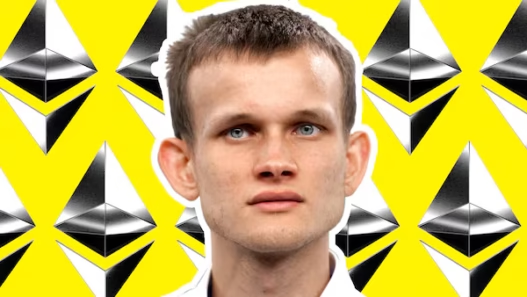
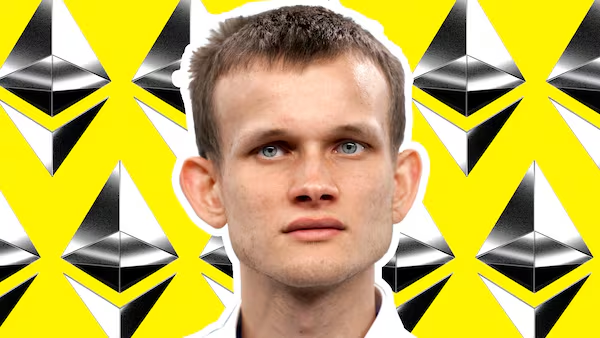
In a recent interview with Foresight News, Vitalik Buterin, a well-known member of the blockchain community and co-founder of Ethereum, discussed how he navigates the prediction market Polymarket.
At this point, he explained that he starts by seeing markets in what he calls “crazy mode,” when he wagers that dire situations won’t materialize.
The co-founder provided an example of a recent market wager that predicts whether US President Donald Trump would win the Nobel Peace Prize in order to further clarify this issue. Buterin said that during times of increased worry, market speculation suggests that the dollar may reach zero in 2027.
Buterin demonstrates how important prediction markets are.
Buterin claimed to have contributed about $440,000 to Polymarket. He made $70,000 in profit, or 16% of his initial investment, after he wagered on the prediction market in 2025. Regarding this profit, the business leader claimed that he frequently makes money by betting against market hype. In order to maximize their profits, he contends that bettors select markets that are motivated by intense, irrational sentiment.
Loxley Fernandes, a well-known Web3 entrepreneur and fintech innovator, and Dastan, CEO of the Dastan company, responded to the Ethereum co-founder’s statement by stating that he thought Buterin’s success came from spotting and making money off of blatantly incorrect assumptions, highlighting the substantial value of prediction markets.
“This is exactly what prediction markets are meant to do: provide clear signals amid all the noise,” he said, adding that “rational players not only make money but also help bring prices back to reality when emotional extremes and irrational feelings affect markets.”
Buterin revealed that betting platforms like Polymarket, like other marketplaces, have significant obstacles, especially with relation to the way oracles function. Notably, oracles are decentralized third-party services that automatically and securely settle market bets by connecting the blockchain with the results of real-world events.
The industry executive gave an example of a prediction market related to the Russia-Ukraine war to illustrate some of the difficulties encountered. People wager on whether the Russian army would take over the Ukrainian city of Myrnohrad in this prediction market. Maps from the Institute for the Study of War (ISW), a nonpartisan, nonprofit think tank located in Washington, D.C., were used by the Oracle for this prediction market.
Courtesy: https://www.covers.com, https://www.casino.org, https://pechanga.net