




















































The internet gambling industry has become a real global business. What was once a set of country-specific operators has become a web of companies serving customers across jurisdictions, languages, currencies and regulatory regimes.
Today, some of the world’s biggest gambling brands are operating in dozens of markets at a time, offering everything from sports betting and live-dealer games to online slots and mobile wagering. Their cross-border scalability has contributed to the creation of a fiercely competitive international industry worth billions of dollars annually.
But behind the apps and websites that are easy to use is an involved business model. International operators must contend with regulatory requirements, payment systems, technology infrastructure and cultural differences while providing a consistent customer experience.
Knowing how an international online casino or a global sportsbook works is very interesting as it is one of the most booming areas of digital entertainment.
The rise of the international gambling market
The explosion of internet connectivity, smartphones and digital payments has hugely improved access to online gambling.
Players no longer have to rely on local betting options. Instead, many operators now have localised platforms for customers in multiple regions to meet the needs of individual markets.
As regulations change globally, operators are looking more and more at international growth strategies. This has created global sportsbook platforms capable of servicing millions of users while providing country- and region-specific products.
International growth has become a key driver of long-term business success for many gambling companies.
Why operators expand into multiple markets
The decision to enter new markets is often a combination of growth and diversification opportunities. Relying on one country can expose an operator to economic fluctuations, regulatory changes or increased competition. Going abroad allows companies to diversify their risk and access larger markets.
And also different regions have other opportunities. In one country, sports betting will likely be king, while in another, online casino betting is more popular. Multi-jurisdictional operations allow companies to create broader revenue streams and diversify their dependency on any one market.
Operating in Diverse Regulatory Frameworks
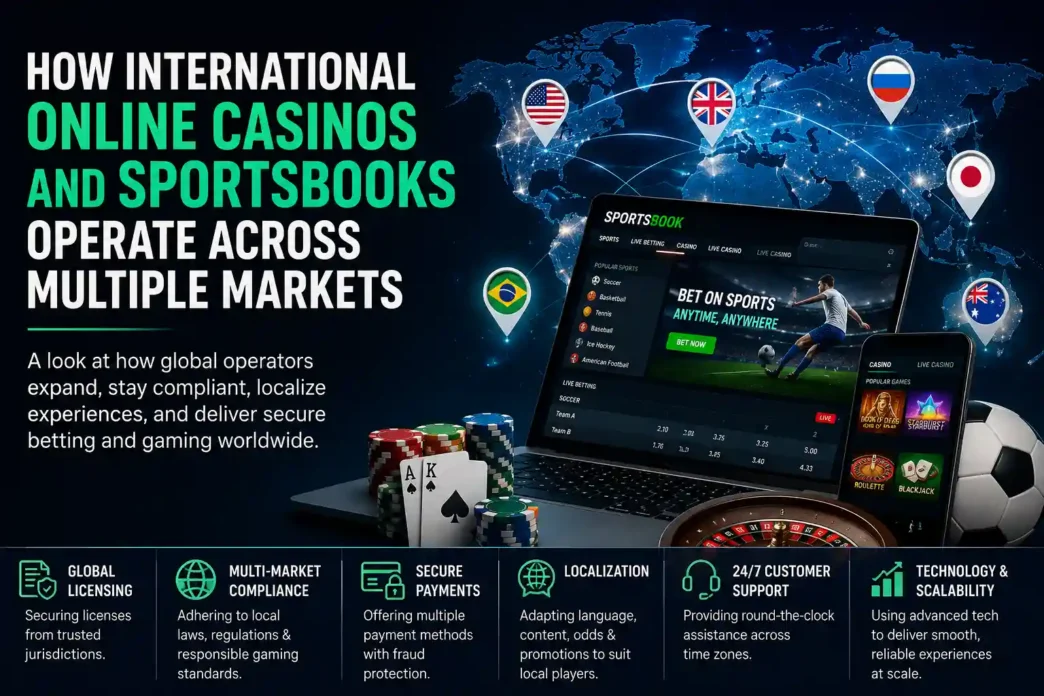
Regulation is one of the biggest challenges facing international betting sites. Each jurisdiction has its own rules for licensing, taxation, advertising, responsible gambling measures and consumer protections. What is allowed in one market may be restricted or prohibited in another.
Consequently, the global operators tend to have dedicated compliance teams whose job is to monitor regulatory changes and ensure the platforms are in compliance with local rules.
In many cases an operator may vary the website, betting products, promotional offers and customer verification processes depending on the location of the user. Regulatory compliance has become one of the biggest operational priorities for international gambling companies.
Localization is more than just language
International operators who are successful know that entering a new market is more than just translating a website. Customer tastes vary widely from region to region. The sports, betting, payment methods and entertainment are all different from country to country.
Its North American site is heavily skewed towards NFL, NBA, MLB and college sports, while its global sportsbook with customers in Europe will focus on soccer markets.
Similarly, an international online casino can customize its games according to the local preferences and player behavior. Localization strategies often involve customer support, marketing campaigns, payment options, and mobile app design.
Software of worldwide sportsbook platforms
Several countries need advanced technology infrastructure. Modern betting platforms need to handle thousands of bets per second, update odds in real time, manage customer accounts, and support a wide range of payment methods.
Cloud computing, data analytics, cybersecurity systems and artificial intelligence are playing more and more important roles in helping operators scale globally. Technology also enables operators to deliver the same experience on desktop computers, smartphones, tablets and other connected devices.
Technology investment has emerged as a key competitive advantage for many firms in the race to attract and retain customers.
Payment systems key for international growth
Payment flexibility is one of the most important factors in expanding internationally. Customers want to deposit and withdraw funds in a way that is familiar and convenient for their region. This means that operators often support a variety of local banking systems, digital wallets, card networks and alternative payment solutions.
Making payments in different currencies and different financial systems can be complex, especially if the regulatory requirements are not the same across jurisdictions. The ability to deliver secure and efficient payment experiences is often a key driver of customer satisfaction and long-term loyalty.
International responsible gambling
As operators grow internationally, responsible gambling obligations become ever more important. In many jurisdictions, licensed operators are required to provide tools to help customers manage their gambling activity. These tools could include deposit limits, self-exclusion programs, spending reminders and account monitoring features.
This is certainly the case for multi-market operators, where harmonizing player protection standards has become a core business activity.
Responsible gambling initiatives are not only satisfying regulatory expectations, but also helping to support the long-term sustainability of the industry.
International operator competition
The global gambling market has become more competitive. The operators no longer compete just on odds or choice of game. User experience, mobile technology, customer service, loyalty programs and product innovation are now important elements in attracting customers.
Many international betting sites spend heavily on technology, partnerships, sponsorships and brand development to cement their place in crowded markets.
Conclusion
Today’s international online casino and sportsbook industry is far more complex than most consumers realize. Behind every betting app or casino platform there is a complex operation dealing with regulations, payments, technology, localization and customer protection in multiple jurisdictions.
With global sportsbook platforms continuing to grow, their ability to cater for different markets whilst also providing a seamless user experience will continue to be one of the key factors impacting the future of online gambling.
The result is an industry that is increasingly interconnected, where global reach and local knowledge must go hand in hand.