




























Tennis is a sport built on solitude, a single player pitted against another with no teammates to rely on, and it is that isolation that makes its greatest rivalries feel so personal. There are a few rivalries that have transcended the single match to become something more like continuing sagas, shaping the memory of whole eras of the sport.
This guide looks at the rivalries that have defined the history of tennis, from the golden age to today’s generation still writing their own chapter.
Björn Borg vs. John McEnroe: Ice Against Fire
Few rivalries provided tennis with such dramatic potential as Björn Borg and John McEnroe. The contrast between Borg’s calm, robotic demeanor on court and McEnroe’s fiery, confrontational style of play meant that every meeting was a battle of opposites before a ball was ever struck.
The pair’s 1980 Wimbledon final is one of tennis’s most storied matches and was constructed around an 18-16 fourth-set tiebreak that many consider the greatest single set of tennis ever played. Borg ultimately won that match, but McEnroe got his revenge the following year, ending Borg’s 5-year reign at Wimbledon and effectively closing out one of the sport’s most compelling short-lived rivalries, as Borg’s early retirement not long after cut their head-to-head short at a moment when it still felt like it had years left to run.
Evert vs. Navratilova
Chris Evert and Martina Navratilova would face each other 80 times in their careers, the most times by any rivalry in the history of men’s or women’s professional tennis. Evert’s consistent, precise baseline game was put up against Navratilova’s aggressive serve-and-volley style again and again to stylize the contrast like the Borg-McEnroe dynamic in the men’s game.
What was special about this rivalry was its sheer length, from the mid-1970s to the mid-1980s and almost every major final in between. Ultimately Navratilova won out in the overall series by a slight margin. But the real legacy of the rivalry is how it elevated women’s tennis at a critical time for the profile and commercial expansion of the sport.
Sampras vs. Agassi
In the 1990s, Pete Sampras and Andre Agassi represented two fundamentally different ways of winning tennis matches. Sampras played a game based on a huge serve and strategic aggression, while Agassi responded with ferocious returns and some of the best baseline shot-making in the game until then.
Their rivalry produced some of the most-watched matches of the decade, including a memorable 2001 US Open quarterfinal that many consider one of the finest matches ever played without a single break of serve across the entire contest. Sampras ultimately held the edge in their head-to-head series, but Agassi’s career longevity, capped by a return to the world’s top ranking well into his thirties, cemented the rivalry as one defined as much by mutual respect as by competitive intensity.
The Big Three: Federer, Nadal, and Djokovic
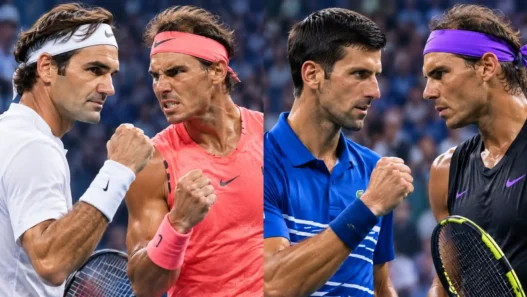
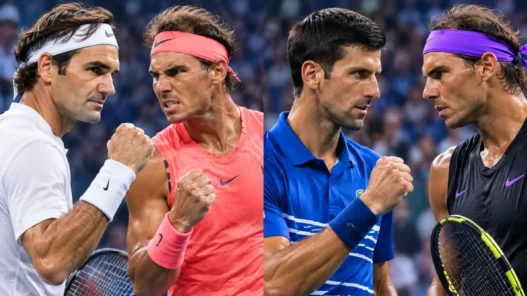
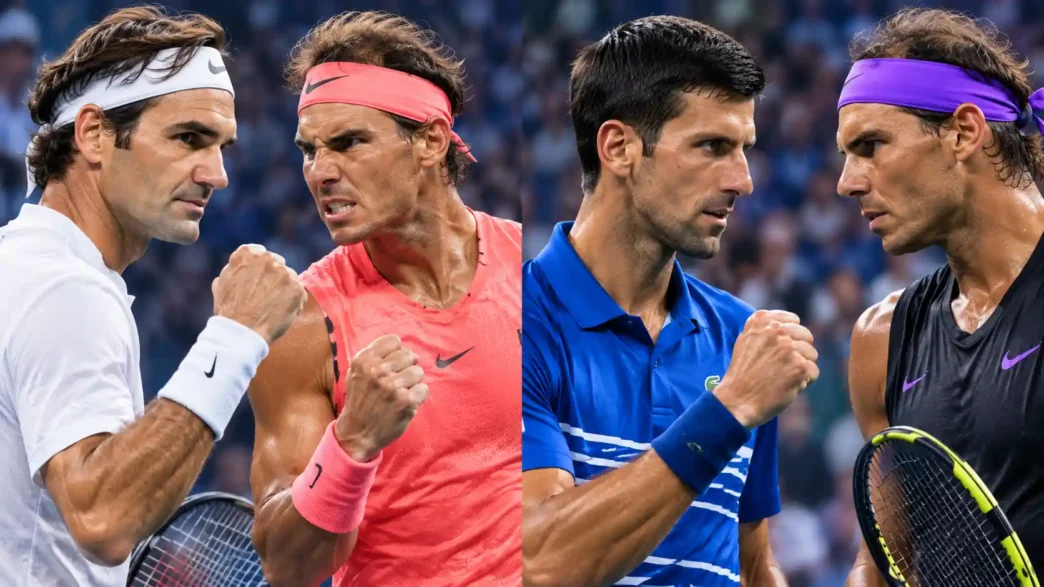
And no discussion of tennis rivalries would be complete without the three-way saga of Roger Federer, Rafael Nadal and Novak Djokovic. A rivalry that dominated the sport for the better part of two decades and produced 66 Grand Slam titles between them. Each of the three pairings developed its own identity, and together they carried men’s tennis to heights of sustained excellence never before seen in the sport.
Nadal and Djokovic met 60 times, the most contested head-to-head in Open Era history, with Djokovic finishing ahead 31 wins to 29. Federer and Djokovic met 50 times, with Djokovic again having the edge, 27-23. Federer and Nadal met 40 times, with Nadal winning the series 24-16, mostly on the back of his dominance over Federer at the French Open.
Some of the matches from this era have become tennis folklore in their own right. The 2008 Wimbledon final between Federer and Nadal, widely considered the greatest match ever played, lasted nearly five hours before darkness nearly ended it. In the 2019 Wimbledon final, Federer had his first championship point against Djokovic serving for the match but the Serb saved that point and went on to win the title in a deciding tiebreak. The 2012 Australian Open final between Nadal and Djokovic is the longest Grand Slam final ever played, lasting five hours and 53 minutes.
Serena Williams vs. Venus Williams
Serena and Venus Williams created a rivalry that was never seen before in the sport of tennis, because it was sisters. They met in nine Grand Slam finals, a record that no other pairing in the history of the sport has come close to matching, with Serena eventually prevailing in their overall head-to-head series.
What was so unusual about this rivalry was the real warmth the sisters maintained off the court, even as they competed directly against each other for the sport’s biggest titles. Their matches helped change women’s tennis commercially and culturally through the 2000s and their combined dominance across singles, doubles and Olympic competition remains one of the most singular achievements in the sport’s history.
Sinner vs. Alcaraz
Jannik Sinner and Carlos Alcaraz’s rivalry has already yielded some of the most dramatic matches of the 2020s, and the present belongs to them. Alcaraz saved match points against Sinner in an epic five-set thriller in the 2025 French Open final and it is already being talked about in the pantheon of great Grand Slam finals in tennis history.
The rivalry has kept making headlines all through 2026. Sinner defended his Wimbledon title this year while Alcaraz, who opened his season with a career Grand Slam at the Australian Open, missed some time with a wrist injury. Both players are still in their early twenties, and Alexander Zverev’s own breakthrough French Open title has added a genuine third contender to the mix. This generation’s rivalry picture looks more layered than the two-man dynamic that defined tennis for much of the past decade, and it’s still very much being written in real time.
What Makes a Tennis Rivalry Truly Great
A few common themes emerge when you look across all of these matchups. The best rivalries usually occur when the two players are most different stylistically. Borg was the patient one, McEnroe the aggressive one. Federer is the elegant one, Nadal the relentless, physical one. It is the contrast of styles that makes it actually unpredictable every time two players play each other.
Length is as important as intensity. The rivalries most fondly remembered today, from Evert-Navratilova’s 80 meetings to the Big Three’s two decades of dominance, earned their legendary status by occurring over years, not a single unforgettable season. Rivalries take time to build real stakes and the very best provided fans with that time in spades.