



























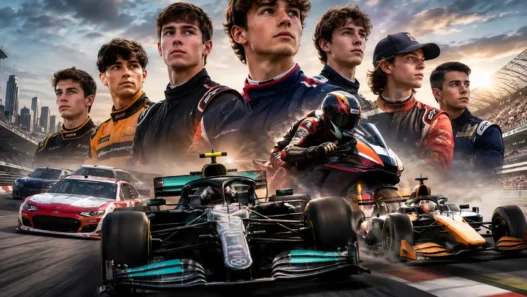


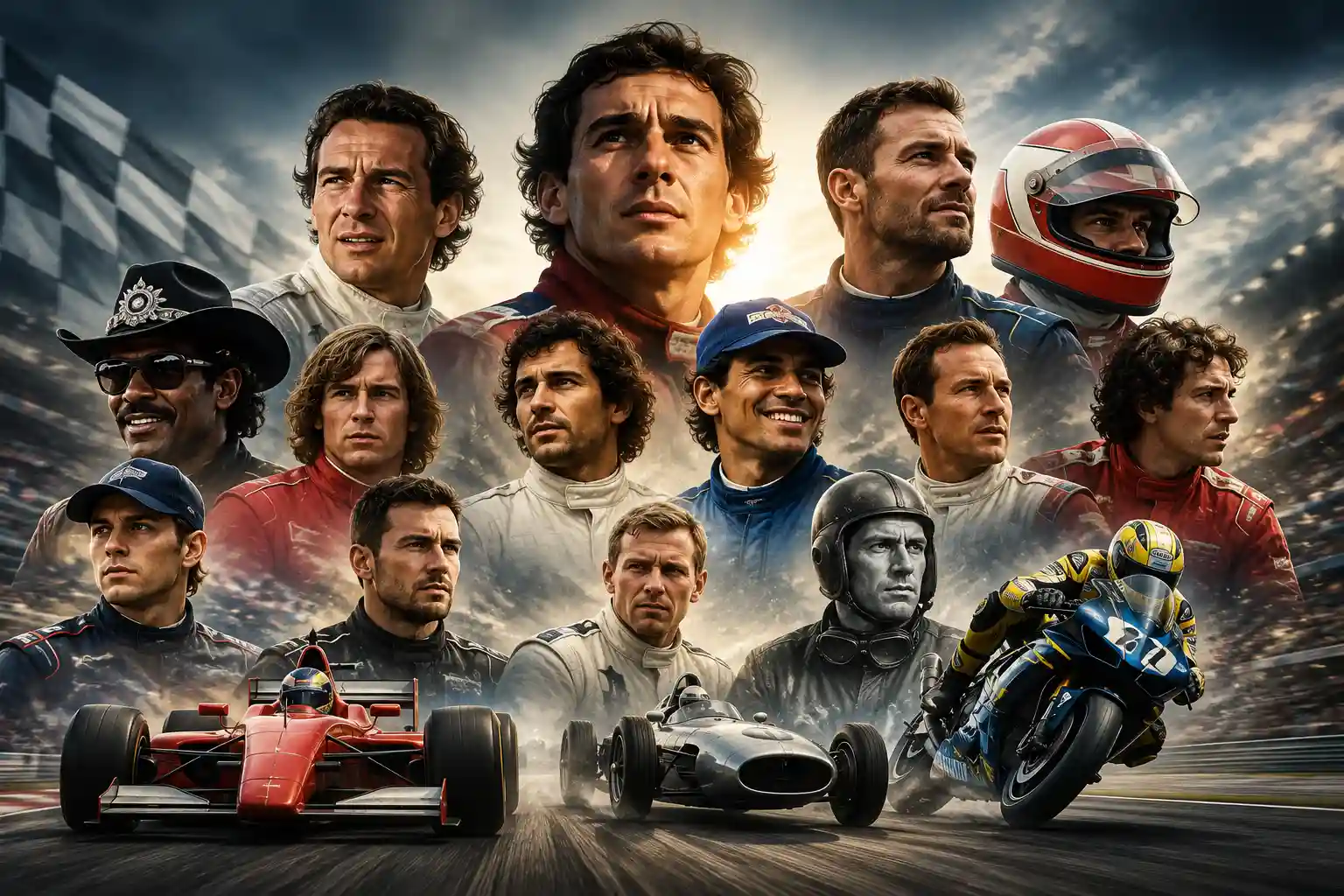






In every generation of motorsport there are a handful of names that transcend the sport. They’re the drivers casual fans know, even if they’ve never sat through an entire race, the ones whose records are pursued for decades, the ones whose driving style or personality altered how an entire discipline is approached.
To be sure, twenty of them are left off the list, and the debate will never be fully settled. This is a trip through F1, NASCAR, MotoGP, IndyCar and more, and the drivers who really changed the course of racing history.
Formula 1
Formula 1 has had a world champion every year since 1950 and a select few names stand out above the rest of the field.
Juan Manuel Fangio set the template for greatness before most of today’s fans were born. The Argentine won five World Championships in the 1950s, driving for four different teams along the way, a level of adaptability that remains almost unmatched in the sport’s history.
Ayrton Senna had injected a raw intensity into F1 the likes of which had never been seen before. Legendary were his qualifying laps at Monaco and his rivalry with Alain Prost defined an era, before his death at Imola in 1994 shook the sport into a new age of safety reform.
Senna’s great rival Alain Prost won four titles with a very different style, based on precision, tyre management and race craft rather than sheer bravado. Fans had every reason to call him “The Professor.”
Niki Lauda won three titles over a two-decade period but his legend is bigger than the trophies. It is still one of the most incredible comeback stories in the history of sport, returning to racing just weeks after a horrific fiery crash at the Nurburgring in 1976.
Michael Schumacher redefined dominance in the modern era, winning seven titles and tearing up the record books for wins, poles and points before Lewis Hamilton eventually matched his championship tally decades later.
Lewis Hamilton then equalled Schumacher’s seven titles, and became the most successful driver in the sport in terms of wins and poles. But beyond the numbers, Hamilton became one of the world’s most recognizable athletes, using his platform to push for conversations about diversity and access in a sport with a history of exclusivity.
The 2021-24 win by Max Verstappen was a record nineteen wins in a single season, bringing to an end four years of domination. His aggressive, uncompromising style makes him one of the most polarising and compelling drivers of his generation, and At just 27, his story is yet to be written, but he consistently remains a heavy favorite year after year. If you are looking to follow the latest odds, check out our guide to the [best online sportsbooks]
NASCAR
Richard Petty Nicknamed “The King”, Richard Petty still holds the record for most Cup Series championships at seven and 200 wins, figures that still serve as the benchmark for any NASCAR driver.
Dale Earnhardt won seven championships himself and earned the nickname “The Intimidator” for a reason: He drove with a fearless, physical style. His last-lap crash in the 2001 Daytona 500 resulted in sweeping changes to the sport’s safety, including the SAFER barriers now standard at every track.
In the 1990s, Jeff Gordon played a key role in modernizing the image of NASCAR, introducing a younger, more refined style to a sport that remained deeply entrenched in its Southern short-track roots. His four championships and rivalry with Earnhardt helped bring a much larger national audience to the sport.
Jimmie Johnson’s five straight titles from 2006-2010 is one of the most dominant championship runs in any American sport and the only sustained excellence of that nature in the Cup Series era.
Tony Stewart won championships in NASCAR’s Cup Series but also was a force on the sprint cars and in IndyCar racing, earning a reputation as one of the most versatile American racers ever, a crossover resume few drivers in any era can match. Tony Stewart
MotoGP
Giacomo Agostini is the most successful Grand Prix motorcycle racer of all time, with 15 world championships in the 350cc and 500cc classes during the 1960s and 1970s. His record probably won’t be broken.
Nine world titles in different engine classes and a fan following that extended beyond the sport made Valentino Rossi the man who turned MotoGP into a global phenomenon. His personality and showmanship brought casual fans to the sport like few athletes in any sport have.
Marc Márquez has become the leading man of his generation, with six premier-class titles to his name and riding on razor-thin margins and a near-supernatural feel for front-tyre grip, despite injuries that have tested his career at multiple points.
IndyCar and America’s Open-Wheel Icons
A.J. Foyt is the only driver to have won the Indianapolis 500, the Daytona 500 and the 24 Hours of Le Mans — a combination of victories in three very different racing cultures that may never be matched.
Mario Andretti enjoyed one of the most celebrated careers in motorsport history with an Indy 500, a Formula 1 World Championship, multiple Daytona 500 appearances, and is one of the only drivers to ever have major success in both American and international racing.
Rick Mears won four Indianapolis 500s, tying the contemporary record of Foyt and Andretti’s A.J. He earned a reputation as one of the smartest, most consistent qualifiers the Brickyard has ever had.
Rally and Endurance Racing’s Greatest
Nowhere in motorsport has anyone dominated a discipline as much as Frenchman Sébastien Loeb did in the World Rally Championship between 2004 and 2012, winning nine titles in a row on some of the most unpredictable terrain in the sport.
Tom Kristensen, “Mr. Le Mans,” won the 24 Hours of Le Mans a record nine times, becoming the defining figure of the sport’s biggest event and proving that consistency over 24 grueling hours is its own brand of greatness.