


























Dark Mode Light Mode

Keep Up to Date with the Most Important News

By pressing the Subscribe button, you confirm that you have read and are agreeing to our Privacy Policy and Terms of Use
Follow Us
Follow Us

Keep Up to Date with the Most Important News

By pressing the Subscribe button, you confirm that you have read and are agreeing to our Privacy Policy and Terms of Use
What is bonus bet conversion? How does it work, and is it worth it?
How to read American odds? What do +200 and -150 mean in sports betting, and what’s best for you?
Hot New Post. Sustainable Architecture for Future Urban Environments

How to read American odds? What do +200 and -150 mean in sports betting, and what’s best for you?

American odds sit at the center of sports betting in the United States. Every moneyline, prop, or futures market is built around numbers like +200, -150, or +300. To a new bettor, they look confusing. To an experienced bettor, they instantly explain risk, payout, and how confident the sportsbook is about an outcome.

Once you understand what these numbers really mean, reading odds becomes second nature, and betting decisions become far more deliberate.

The basic idea behind American odds

American odds are designed around a $100 reference point. The odds show either how much profit you can win from a $100 bet or how much you must stake to earn $100 in profit. The sign in front of the number does most of the talking.

A plus sign means you are betting on an underdog. A minus sign means you are backing a favorite. The size of the number shows how big the risk or reward is.

This format appeals to US bettors because it connects odds directly to real money rather than percentages or fractions.

How positive odds work in real terms

Positive odds like +200 or +300 show how much profit you make on a $100 wager.

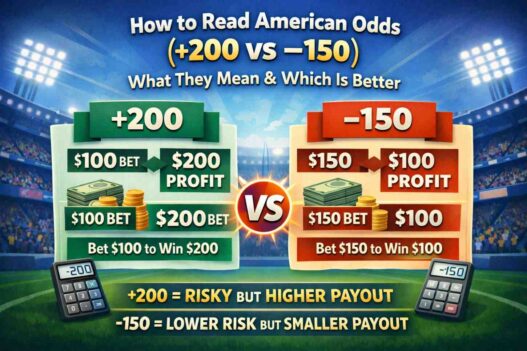
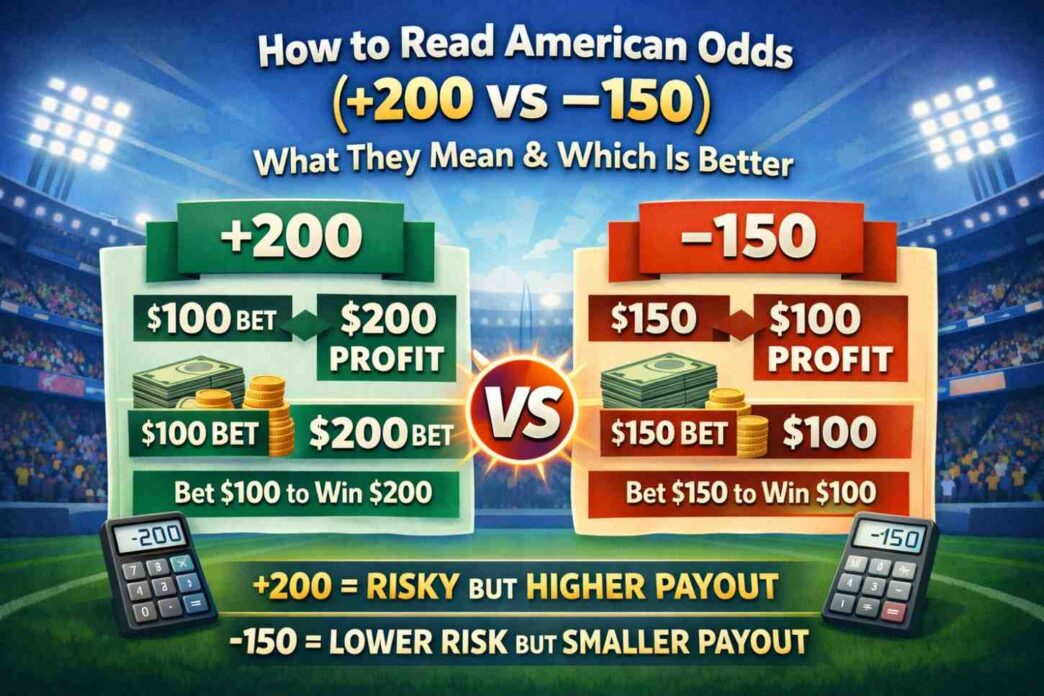
If you see +200, a $100 bet wins $200 in profit. Your total return is $300, including your stake. If you bet $50 instead, the profit would be $100. The math scales up or down, but the relationship stays the same.

Positive odds usually belong to teams or players the sportsbook believes are less likely to win. That lower expectation is why the payout is higher if the bet comes through.

Understanding what -150 really means

Negative odds flip the equation. Instead of showing profit on a $100 bet, they show how much you must risk to win $100.

At -150, you need to bet $150 to earn $100 in profit. If you only stake $100, your profit would be roughly $66.67. If the bet wins, your total return would be your stake plus the profit.

Odds like -150 indicate a favorite. The sportsbook believes this outcome has a stronger chance of happening, which is why the reward is smaller relative to the risk.

Why +300 is more than just a bigger number

Odds of +300 signal a clear underdog. A $100 bet at +300 returns $300 in profit, for a total payout of $400. These odds often appear in futures markets, player props, or games where one side is heavily favored.

While the payout looks attractive, bets at +300 lose more often than they win. This does not make them bad bets, but it does mean they require better judgment. Value matters more than the size of the payout.

How odds reflect sportsbook expectations

American odds quietly communicate probability. Lower odds suggest a higher likelihood of winning, while higher odds suggest a lower chance.

A -150 favorite is expected to win more often than a +200 underdog. A +300 long shot is expected to win even less frequently. Sportsbooks use these expectations to balance action and manage risk.

For bettors, understanding this relationship helps separate smart bets from emotional ones.

Choosing between +200, -150, and +300

There is no “better” number by default. A -150 bet may feel safer, but repeated small edges matter more than short-term comfort. A +200 bet may look risky, but it can be profitable if the odds underestimate the true chance of winning. A +300 bet can be useful in specific situations, but chasing them blindly usually leads to losses.

Smart bettors focus on whether the odds offer value, not whether the payout looks exciting.

Why American odds reward discipline

Because American odds clearly show risk and reward, they encourage disciplined betting. You always know what you stand to win and what you are risking. This makes bankroll management easier and reduces impulsive decisions.

Once you are comfortable reading odds like +200, -150, and +300, you stop guessing and start evaluating bets logically.

Keep Up to Date with the Most Important News

By pressing the Subscribe button, you confirm that you have read and are agreeing to our Privacy Policy and Terms of Use
Previous Post

What is bonus bet conversion? How does it work, and is it worth it?