










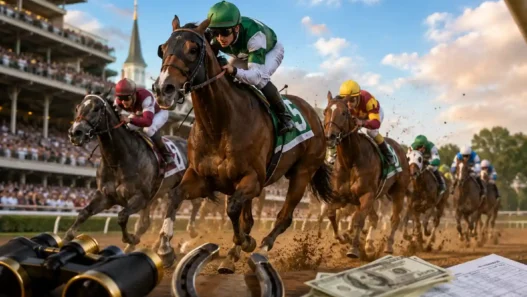
































Horse racing has a different kind of tradition than most American sports, blending centuries of history with a betting culture that has been part of the experience from day one. Unlike stick and ball sports that are based around teams and seasons, racing is a series of individual events and learning how those events actually work, from race classifications to the wagering menu at the betting window, makes the whole sport much more rewarding to follow.
This guide will make clear the basic rules of thoroughbred racing, the different types of races you will find, and how betting actually works at the track, all during this year’s truly dramatic Triple Crown season.
The Basics: What Makes a Race a Horse Race
Thoroughbred racing is a competition of horses over a fixed distance, usually expressed in furlongs (an eighth of a mile). The distances covered are usually from short sprints of around five or six furlongs to longer distance races of a mile and a half. That range of distances is very important because horses tend to be specialists. They are either sprinters, bred for a short burst of speed, or stayers, capable of maintaining a pace for a longer run.
Jockeys are the riders who guide horses through a race, working closely with trainers, who handle a horse’s training, and owners, who pay the bills and take the purse if the horse does well. Another part of post position is that the horse’s position relative to the inside rail can have a meaningful impact on his chances based on the distance of the race and the track. This is one reason draw position gets so much attention in pre-race analysis.
Races are run on dirt or turf, sometimes called grass, and a horse’s record on each surface is often one of the clearest indicators that bettors and handicappers look at when handicapping an upcoming race. Some horses run considerably better on one surface than the other, similar to how tennis players play differently on clay, grass, and hard courts.
Understanding Race Classifications
Not every race is created equal in terms of competition and horse racing has a tiered system of classification to distinguish between levels of talent. Maiden races are for horses that have never won a race and they give newcomers something to aim at until they are able to step up to the plate and take on more established company. Claiming races allow any licensed person to “claim” or purchase a horse running in that race for a set price, which helps keep fields competitive by grouping horses of real comparable ability and value together.
Allowance races are a step up from claiming races. The horses in these races have demonstrated enough ability to avoid being put up for a claiming price, but they have not yet reached the highest level of the sport. Stakes races are the highest level of the sport, with the best horses racing for the biggest purses. Graded stakes races are even more exclusive and have a classification system of Grade 3 through Grade 1, where Grade 1 races are the most prestigious and competitive races run anywhere in the world.
The Triple Crown: American Racing’s Biggest Stage
One of the most compelling storylines in horse racing is the Triple Crown, three races in the spring for three-year-old horses: the Kentucky Derby, the Preakness Stakes, and the Belmont Stakes. It’s one of the rarest achievements in American sports to win all three in the same year, something that has only been done 13 times since Sir Barton did it in 1919. The last horse to do it was Justify in 2018.
There was plenty of drama in this year’s Triple Crown season without a sweep. Golden Tempo (25-1), trained by Cherie DeVaux, held off Renegade by a neck to win the 2026 Kentucky Derby, marking the first time a female trainer has won the race. Golden Tempo’s connections opted to pass on the Preakness Stakes two weeks later, a choice that left the door open for Napoleon Solo to win that middle jewel of the Triple Crown. Golden Tempo then returned for the Belmont Stakes at Saratoga Springs, rallying from the back of the pack to win by just over a length and capture two of the three Triple Crown races, making it the second consecutive year that a Kentucky Derby winner accomplished the Kentucky-Belmont double after skipping the Preakness.
That decision has started a real debate in the sport over the current schedule of the Triple Crown, which stages all three races in just five weeks. With more Derby winners skipping the Preakness, industry officials have talked of possibly adjusting the spacing between races, a move that could change the series’ dynamics in coming years.
How Horse Racing Betting Actually Works
The simplest horse race wager is a win bet, which is a bet that the horse you choose will finish in first place. Place bets pay if a horse finishes 1st or 2nd . Show bets pay if a horse finishes in the top 3 . Place and show bets pay less but have a higher chance of cashing than the win bet.
In addition to these basic bets, horse racing has many exotic bets that require you to pick multiple horses in 1 or more races. With exacta bets, you have to select the top two finishers in the right order. Trifecta wagers are the same concept except for the top three finishers . Superfecta wagers require you to get the top four in order . The payout is greatly increased by the increased difficulty of the prediction.
Multi-race wagers add another dimension entirely. A daily double requires picking the winner of two consecutive races, while a pick-six challenges bettors to correctly select the winner of six consecutive races, a bet that can produce massive payouts precisely because of how difficult it is to get right. These multi-race and multi-horse exotic wagers are part of what makes horse racing betting feel meaningfully different from picking a single winner in most other sports.
How Odds and Payouts Are Determined
Horse racing uses a pari-mutuel betting system, which works differently from the fixed odds you’ll find in most other sports betting markets. Rather than a sportsbook setting the odds in advance, all money wagered on a particular bet type gets pooled together, and payouts are calculated based on how that pool gets divided among the winning bets, with the track and state taking a percentage off the top before payouts are calculated.
This means the odds you see posted before a race are estimates that shift continuously as more money comes in, reflecting the betting public’s collective view of each horse’s chances right up until the race actually begins. A heavily bet favorite will pay relatively little on a win bet, while a long shot with little betting action can pay out dramatically more, exactly the dynamic that made Golden Tempo’s 25-1 Kentucky Derby win such a lucrative result for bettors willing to back him.
Reading a Race Program and Past Performances
Serious bettors typically rely on a race program, sometimes called a racing form, which compiles detailed past performance data for every horse entered in a race. This includes recent finishing positions, the class level of previous races, jockey and trainer statistics, workout times leading up to the race, and notes on surface and distance preferences.
Understanding how to read this information takes some practice, but it’s central to how experienced bettors approach handicapping a race rather than simply picking based on a horse’s name or post-time odds alone. Factors like whether a horse is moving up or down in class, how it has performed after a layoff, and how a particular jockey-trainer combination has historically performed together can all provide meaningful context that raw odds alone don’t fully capture.
Why Horse Racing’s Betting Culture Feels Different
Few sports have betting so ingrained in their identity as horse racing, where the pari-mutuel system and centuries of tradition have cultivated a wagering culture that is distinct from the fixed-odds sportsbooks that are now ubiquitous across the rest of the major sports. The sheer array of bet types, from straightforward win bets to intricate multi-race exotic wagers, offers horse racing bettors a strategic depth unmatched in most other sports.
That depth is part of the allure for fans and bettors who follow the sport year-round. But you can get some very good stories out of a single Triple Crown season, as the Golden Tempo Preakness debate this year clearly demonstrates. The sport’s grading system and pari-mutuel betting structure reward those who are willing to get into the nitty-gritty rather than just pick a favorite and hope for the best.