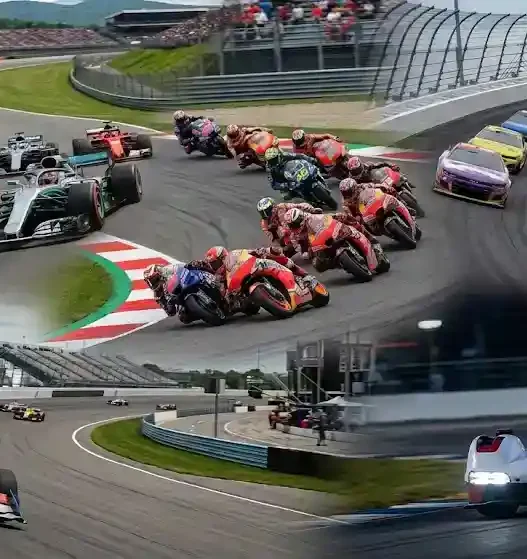



































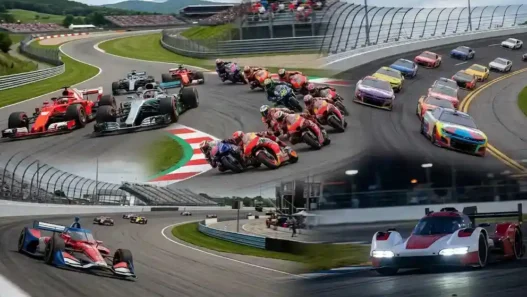











Motorsport betting is one of the more interesting corners of the sports wagering world and it works a little differently to betting on team sports. It’s not a yes or no, win or lose, point spread in the traditional sense and there are twenty-plus cars on the grid every weekend instead of two teams.
That can make the odds of racing seem a little confusing on first glance to newcomers. Once you understand how sportsbooks set their odds on these markets and what bets you can actually make, motorsport betting becomes one of the more engaging ways to follow F1, NASCAR, MotoGP and IndyCar through a season.
Understanding Odds Formats
It helps to understand how odds are actually displayed, before we get into race specific markets. Most American sportsbooks will show the odds as a positive or negative number, known as moneyline odds. If you see a driver listed at plus-400, that means a $100 bet would win you $400 in profit if that driver wins. If you see a driver listed at minus-150, that means you’d have to bet $150 to win $100, which reflects that they’re considered a heavier favorite.
Decimal odds are more common internationally, though increasingly visible on US platforms, and work a little differently. A decimal of 5.00 means a $100 bet returns $500 in total including your original stake, whereas a shorter decimal of 1.50 is indicative of a heavy favourite. Fractional odds are the traditional British way of expressing odds and they are expressed as a ratio such as 4/1 or 6/4. You’ll still see fractional odds in some racing-specific markets, especially for motorsport events that have strong British roots.
The principle stays the same no matter what format the sportsbook uses. Shorter odds mean a greater likelihood of a win, whereas longer odds mean a bigger payout for a less likely outcome.
Outright Winner Markets: The Foundation of Racing Betting
The most elementary wager of any of these four series is simply picking who wins the race outright, sometimes known as the ‘win market’. Sportsbooks set the odds on every driver or rider entered based on recent form, qualifying performance, track history and machinery.
This market is often heavily influenced by qualifying results in Formula 1, as track position is critical given how hard it can be to overtake at certain circuits. A pole-sitter in a dominant car will often have very short odds, sometimes odds-on, meaning the sportsbook thinks they are more likely than not to win.
NASCAR’s outright markets are a lot flatter across the board. With pack racing, cautions and late-race chaos all being able to drastically shuffle the running order, even a driver starting mid-pack can have realistic winning odds. This is part of the reason that NASCAR betting markets often feature a wider spread of competitive prices than you’d see in Formula 1.
MotoGP and IndyCar are kind of in the middle of that, with big favorites emerging due to recent form and circuit type but enough unpredictability from crashes, tire strategy and weather that outright markets rarely get as one-sided as F1’s tightest races.
Beyond the Win Market: Podium, Head-to-Head, and Prop Bets
You don’t need to bet on an outright winner to bet on a race weekend and lots of bettors like to look for markets where there’s a better chance of getting paid even if the actual prize is smaller. Podium finish bets (or “top 3” or “top 5” markets, depending on the series) let you bet on a driver finishing in a certain range, rather than having to pick a winner.
One of the most popular betting types has been head-to-head matchups in both Formula 1 and MotoGP betting. Instead of choosing a winner from a full field, you are simply choosing which of two named drivers finishes ahead of the other in a specific race, a market that removes the need to correctly identify a dominant favorite and instead focuses on a particular rivalry or teammate battle.
Proposition bets, or “props,” round out the menu and can get quite specific. You’ll often find markets for fastest lap, first driver to retire, safety car probability, pole position winner and margin of victory in major Grands Prix. In NASCAR sportsbooks will often have props associated with stage winners, given how much stage points factor into that sport’s scoring system.
Futures Betting: Championships and Season-Long Markets
Futures markets allow bettors to place wagers on outcomes that won’t be decided for months, such as which driver will win the season championship, which team will win the constructors’ or manufacturers’ title, or which rookie will finish highest in the standings. Odds move constantly through a season as form changes, so a futures bet placed in March can look very different in value when September rolls around.
Championship futures are especially popular in Formula 1 and NASCAR, where the storylines around title contenders build up over many months. In F1, futures odds can be a reflection of a driver’s talent, but also the competitiveness of his car, which is why even elite drivers can have long odds if their team isn’t fighting at the front of the grid. NASCAR has a Chase-like playoff system, and the total number of points a driver has during the regular season determines his seed for the postseason, which is made up of 10 races. Sportsbooks take this into consideration and adjust the odds of the championship accordingly.
What Makes Motorsport Betting Different From Team Sports
Betting on traditional stick-and-ball sports is about two sides playing against each other, and a point spread that is supposed to balance the market. With motorsport betting, you’re dealing with a big field of individual competitors, so sportsbooks have to price up twenty-plus separate probabilities instead of just one binary outcome. This is part of the reason racing odds can look so different to what NFL or NBA bettors are used to seeing.
Variance also is a dominant factor. One mechanical failure, one driver error or an unexpected change in weather can turn a race that looked settled on its head beforehand. This happens far less frequently in team sports where substitutions and depth can absorb one bad moment. That unpredictability is precisely why motorsport markets are attractive to many bettors in the first place, creating real value opportunities for those who follow the sport closely enough to spot mispriced odds around specific circuits, weather forecasts or recent mechanical trends.
Tips for Approaching Motorsport Betting Responsibly
In motorsport betting it is more important than in almost any other category to be a follower of the sport, as qualifying results, pace in practice sessions, tire strategy and even the wind direction at a particular circuit can significantly alter the likely outcome of a race. The bettors who are consistently in touch with this information generally have an edge over those that just rely on name recognition or season-long reputation.
Also worth noting is that racing has a bit of real mechanical and situational randomness that no amount of research can really account for, more so than most sports. The best way to think about motorsport betting is as a form of entertainment on top of a sport that you already love, not as a guaranteed source of profit. As with all sports gambling, it is important to set a budget before you begin and stick to it.