
































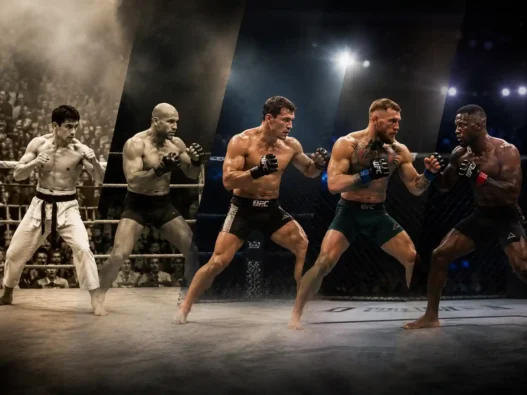
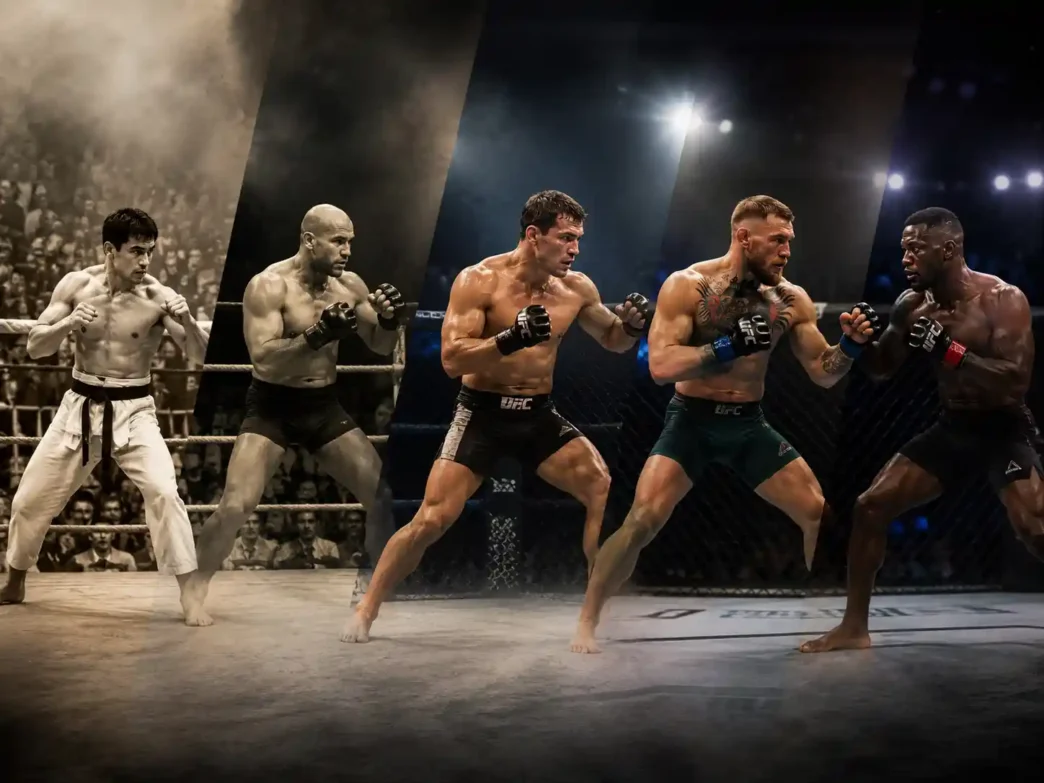
Mixed martial arts is a very different sport now than it was in the early days when it first gained a wider audience. In modern MMA, there are weight classes, standardized rules, professional judges, specialized training camps, and athletes who spend years learning various fighting disciplines. Now fighters walk into the cage with teams of coaches, nutritionists and sports scientists behind them, and major promotions hold events for audiences on every continent.
But that transformation didn’t happen in a day. The history of MMA is the result of decades of experimentation, rule changes and the merging of different combat sports. What began with relatively open competitions gradually developed into a regulated professional sport, with the UFC and other MMA promotions helping take it to a global audience.
What is mixed martial arts?
Mixed martial arts is a full-contact combat sport that brings together techniques from disciplines such as boxing, wrestling, Brazilian jiu-jitsu, Muay Thai, kickboxing, judo and karate.
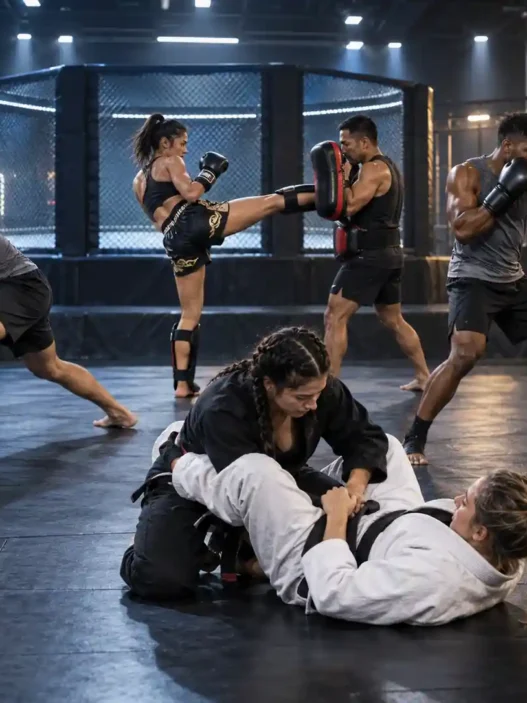
Unlike sports that emphasize one fighting style, MMA allows competitors to alternate between striking and grappling in a single contest. A fighter can attack with punches and kicks while standing, take an opponent to the ground, try for submissions or use wrestling to control position.
One reason the sport continues to draw athletes from all disciplines of martial arts is the versatility necessary to be successful.
The early roots of MMA
The concept of mixing different fighting styles is much older than the modern sport. Fighters with different approaches have been holding combat competitions all over the world throughout history.
Brazil was a major influence, where Vale Tudo fighting became popular in the 20th century. These rather open fights brought together practitioners of different martial arts and helped create an environment in which fighters could test whether one discipline could defeat another.
Brazilian jiu-jitsu later became particularly influential after members of the Gracie family demonstrated the effectiveness of ground fighting against larger opponents. Meanwhile, Japan developed its own hybrid combat scene with professional wrestling and other martial arts contributing to the mixed-style competition.
The UFC changes the conversation
Much of MMA’s modern history has to do with the 1993 launch of the Ultimate Fighting Championship. The first UFC event was in part a tournament to determine which martial art was the most effective in a fight of different disciplines. Fighters came in without the extensive cross-training that is commonplace today and the rules were far less developed than the rules used in modern MMA.
Early events helped to reveal one important lesson: success was based on more than one discipline. Wrestlers, strikers and grapplers all had their strengths but fighters who could combine techniques from multiple disciplines eventually had a huge advantage.
From style vs style to complete fighters
One of the biggest developments in the evolution of mixed martial arts was the breaking down of the traditional “style versus style” concept. In the early days, fighters would often enter MMA with a strong background in 1 specific discipline. As one aspect of the game could be exploited quickly, fighters started to train in several areas over time.
If you can’t defend takedowns as a striker you’re going to get taken to the ground. A good kickboxer can have a hard time of it if faced with a bad striker. Therefore the modern MMA fighter became a specialist in different disciplines and not a pure representative of one martial art. Today, elite camps typically combine wrestling, boxing, kickboxing, Brazilian jiu-jitsu, strength training and conditioning into one preparation program.
The introduction of unified rules
As MMA expanded, regulatory changes became increasingly important. Early competitions were criticized for having limited rules and inconsistent oversight. Athletic commissions and governing bodies gradually introduced regulations covering fouls, rounds, judging, weight classes and fighter safety.
Eventually the Unified Rules of Mixed Martial Arts were created and adopted by many of the professional MMA organizations. The introduction of weight classes was especially important because it minimized size disparities that plagued some of the early bouts. These changes helped to transform MMA from a spectacle of controversy into a regulated professional sport.
The rise of weight classes
Weight classes changed the competitive nature of MMA. Modern promotions pit fighters into divisions by weight, rather than have athletes of vastly different sizes fight each other regularly. This allows for speed, technique, conditioning and strategy to play a bigger part in the outcome.
The UFC has a variety of men’s and women’s divisions with their own rankings and championship systems. Other promotions have similar systems but the specific divisions and limits may be different. Weight classes also gave fighters more defined career paths. An athlete could build a resume in one division, beat ranked opponents and eventually vie for a title.
The evolution of MMA training
MMA training has gotten so much more advanced. The early fighters relied heavily on their primary discipline techniques. Modern competitors are usually training in a number of areas throughout the year, with different coaches responsible for wrestling, striking, grappling and physical preparation.
Video analysis is now utilized in training camps to see an opponent’s habits, tendencies and weaknesses. Strength and conditioning programs are tailored to the particular demands of MMA, and nutrition and recovery have become integral components of preparation.
The result is a crop of athletes that are more well rounded than fighters from the early days of the sport.
How MMA promotions expanded the sport
The rise of major MMA organizations helped the sport to evolve from a series of regional fights into a worldwide entertainment industry.
The UFC became the most recognizable organization, but promotions such as PRIDE Fighting Championships, Strikeforce, Bellator, ONE Championship and others have also played important roles in the development of MMA.
Organizations created their own rules, weight classes, tournament formats and regional stars. Some promotions focused heavily on certain markets, helping MMA build audiences in North America, Japan, Europe, Asia and elsewhere. The rivalry between promotions also created opportunities for fighters to forge careers outside the UFC.
The influence of PRIDE and Japanese MMA
Japan was a huge part of the evolution of modern MMA. PRIDE Fighting Championships was a dominant promotion in the sport during the late 1990s and 2000s . It attracted big stars and had a different style of presentation. Its events helped turn fighters like Fedor Emelianenko, Wanderlei Silva, Antonio Rodrigo Nogueira and Mirko Cro Cop into international names.
The promotion eventually folded, but its influence lives on in the careers and fighting styles of the athletes that came out of that era.
The emergence of global MMA stars
As MMA became more professionalized, fighters began to develop fan bases far beyond their home countries. Georges St-Pierre has helped to make Canada a major market for MMA. Anderson Silva turned himself into one of Brazil’s biggest combat sports stars, while Khabib Nurmagomedov helped to bring huge attention to MMA across Russia and the wider region.
MMA fighters like Israel Adesanya, Amanda Nunes, Valentina Shevchenko and Zhang Weili, along with Conor McGregor’s example of how to become a mainstream global celebrity, have all helped to grow its international appeal. Those fighters showed that MMA could create stars who could draw audiences far larger than the traditional combat sports world.
Women’s MMA becomes a major part of the sport
Women’s MMA has experienced one of the most significant changes in the sport’s modern history. Fighters like Ronda Rousey have helped change the way people think about women fighting in MMA. Rousey’s Olympic judo background and submission-heavy approach made her one of the sport’s biggest draws, and the UFC’s introduction of women’s divisions gave female fighters a major global platform.
Amanda Nunes would go on to become one of the most decorated champions in women’s MMA, and fighters like Valentina Shevchenko, Zhang Weili and others would elevate the competition level. Women’s divisions are now a staple of major MMA cards.
Technology changes modern MMA
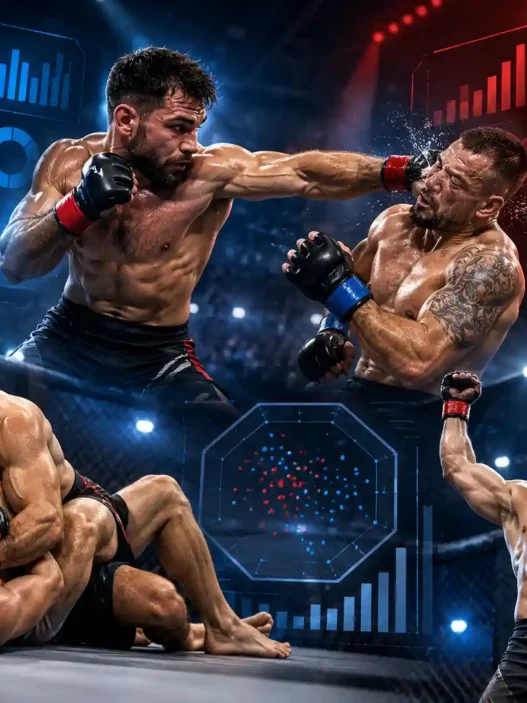
Technology is another important aspect of the evolution of MMA. With data, coaches can now review extensive fight footage and analyze striking accuracy, takedown success, defensive tendencies and other performance indicators. Progress in rehabilitation, nutrition and physical conditioning also helps athletes.
Broadcast technology has changed the way fans experience fights, too. With streaming services and social media, audiences can follow fighters between events, watch training footage and get highlights almost immediately. This has allowed promotions to build international fan bases without the need for traditional television.
MMA today
Modern MMA is a professional sport on the world scale with athletes coming from different martial arts and countries.
The best fighters should be comfortable in all phases of a fight. They have to know how to strike at range, defend takedowns, wrestle against the cage, escape submissions and keep their conditioning over multiple rounds.
At the promotional level, championship belts, rankings and ever more sophisticated matchmaking have produced a recognizable competitive structure. Title fights and rising prospects and established stars can all be on the same card for major events.