











































UFC betting is a whole different animal than most team sports wagering. There’s no countdown clock for a season, no long sample size of games to lean on, just two athletes, a fight that could last nine seconds or twenty-five minutes, and a betting menu built specifically around that uncertainty. Knowing how MMA odds work and what distinguishes a savvy prop bet from a toss-up adds a lot more reward to following the sport.
This guide will walk you through how UFC betting markets work, the prop bets to know, and how to interpret fight predictions with real-world scenarios against the backdrop of the current championship landscape.
Understanding Moneyline Odds in MMA
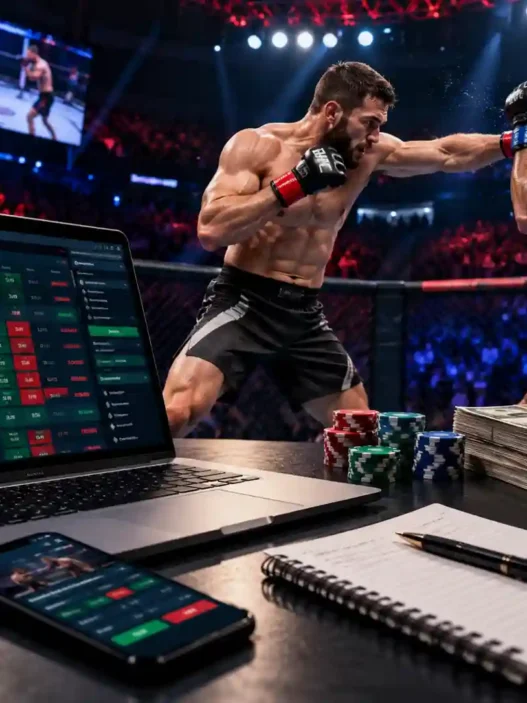
In a one-on-one combat sport like UFC, there is no equivalent of a point spread; UFC betting is all about the moneyline. Odds are displayed in the same manner as other American sports betting markets, with a favorite being shown as a negative number and an underdog being shown as a positive number. For instance, a fighter at minus-300 is a heavy favorite, meaning you’d have to bet $300 to win $100, and a fighter at plus-250 is an underdog, meaning you’d win $250 on a $100 bet.
MMA lines tend to move a lot more than team sports lines since news, change of fight camp, injury reports or even how a fighter looks during open workouts can move a line quite a bit in the days leading up to an event. This is why serious MMA bettors watch the line movement of a fight closely, rather than locking in an opinion the moment a bout is announced.
Why Styles and Matchups Matter More Than Records Alone
When it comes to MMA betting, a fighter’s win-loss record is only part of the story. Stylistic matchups often matter more than pure records when it comes to predicting an actual outcome. A dominant wrestler who has suffocating top control can look like a whole different animal against an opponent with elite takedown defense than against one who struggles to get back to his or her feet. Recognizing these stylistic matchups is key to reading a fight correctly.
This is well illustrated in the current welter and lightweight pictures. Islam Makhachev solidified his dominance and rare double-champion status by moving up to defeat Jack Della Maddalena for the welterweight title with suffocating grappling that neutralises opponents regardless of their striking reputation. On the other hand, interim lightweight champion Justin Gaethje is a very different kind of live betting threat. Gaethje is a forward pressure fighter with heavy hands and the ability to end a fight in one exchange, even against a more technically decorated fighter. Betting lines factor in these stylistic dynamics, which is why a fighter with a “worse” record can sometimes open as a betting favorite against a technically superior opponent whose style plays into their hands.
Method of Victory: A Core UFC Prop Market
Method of victory props require bettors to predict not only the winner but how the fight ends. They are generally broken down into three primary outcomes: knockout or technical knockout, submission or decision. These markets exist because fighters are often easily identifiable with their tendencies, some finishing the vast majority of their fights early, others consistently grinding out decisions against durable opponents.
Featherweight champion Alexander Volkanovski, who defended his title against Diego Lopes earlier this year via unanimous decision, has built a reputation as a fighter who can win by finish or by decision, meaning his method-of-victory odds are truly competitive across multiple outcomes. In general, a fighter with a high finishing percentage in the majority of their career wins will have shorter odds on a KO or submission prop in particular, as the betting market believes a decision is a relatively unlikely outcome for that specific matchup by comparison.
Round and Time Props
Round betting takes the concept of method of victory to the next level, forcing bettors to call the round a fight will end or even the time period within a round. These markets reward bettors who analyze a fighter’s usual pacing, as some fighters always seek to finish fights early with an aggressive start, while others tend to wear opponents down gradually over several rounds before finishing.
Over/under round totals are similar to totals betting in other sports, and ask if a fight will go more or fewer rounds than a set number. When you’ve got two durable, well-conditioned fighters with good chins that tends to push these totals higher, and when you have two aggressive finishers with proven knockout power in either hand, the total is often lower, reflecting the higher chance of an early finish.
Parlays, Same-Fight Multis, and Live Betting
UFC cards usually have 10+ fights which makes them perfect for parlay betting, where you combine the outcomes of several fights into one bet and increase your potential payout. Same-fight multis take this a step further, and match a fighter to win with a method of victory or round. This bet type can pay out a lot higher than a straight up moneyline pick if a bettor has true conviction on how a given fight will play out.
Live, in-play betting has also become a significant part of how fans engage with UFC cards, with odds updating in real time as a fight progresses. A fighter who starts slowly but appears to be finding their rhythm in the second round might see their live odds shift considerably compared to the pre-fight line, creating opportunities for bettors watching closely enough to react before the broader market catches up.
Reading Title Fights and Championship Implications
Title fights have their own particular betting dynamics, as a five-round championship fight gives both fighters much more time to work than the typical three-round undercard fight. The extra distance tends to favor fighters who are well conditioned and patient with their tactics and is one of the reasons some fighters who struggle in a shorter fight are actually more successful when they are bumped up to championship-level five-round fights.
There are many champions in the current UFC landscape who have established themselves as five-round fighters, which is an important when bettors evaluate their fights. Women’s flyweight champion Valentina Shevchenko, the longest-reigning current titleholder in the promotion, has built her championship run on precisely this kind of measured, high-output pace sustained across a full five-round distance, a pattern serious bettors weigh heavily when assessing her odds in any new title defense.
Why Recent Title Changes Matter for Betting Markets
The UFC’s championship picture has changed quite a bit over the past year and each new title change resets the betting landscape for that entire division. Petr Yan won the bantamweight title back from Merab Dvalishvili and Joshua Van took the flyweight title from Alexandre Pantoja, both adding new championship angles that bettors are still getting used to as each new champion makes their first title defense.
This kind of rotation matters because the betting market tends to have different expectations for a first-time champion than for a proven, multiple-time winner. Typically, MMA markets are less efficiently priced and less certain for a champion’s first title defense than they are for a fighter who has already shown their championship level form on multiple occasions, and this is the type of situational nuance that is rewarded for bettors that follow the sport closely rather than just betting based on name recognition or reputation.
Approaching UFC Betting Responsibly
More successful MMA bettors also tend to distinguish themselves from the rest of the crowd by closely tracking training camp updates, weigh-in results, and recent performance trends of a fighter after training camp. Weight cuts in particular are a big one to focus on. A fighter who looks like they’re struggling to make championship weight, or who looks markedly depleted at weigh-ins, can be a huge red flag that raw pre-fight odds don’t always fully account for.
It is also worth remembering that there is an element of unpredictability to MMA that even the most exhaustive research can not completely account for, as one unexpected punch or scramble in a grappling exchange can end a fight in a matter of seconds no matter how the fight was expected to play out beforehand. The most sensible and sustainable way of approaching these markets over a full fight calendar is to look at UFC betting as a fun way of following a sport you already enjoy and set yourself a budget in advance.